
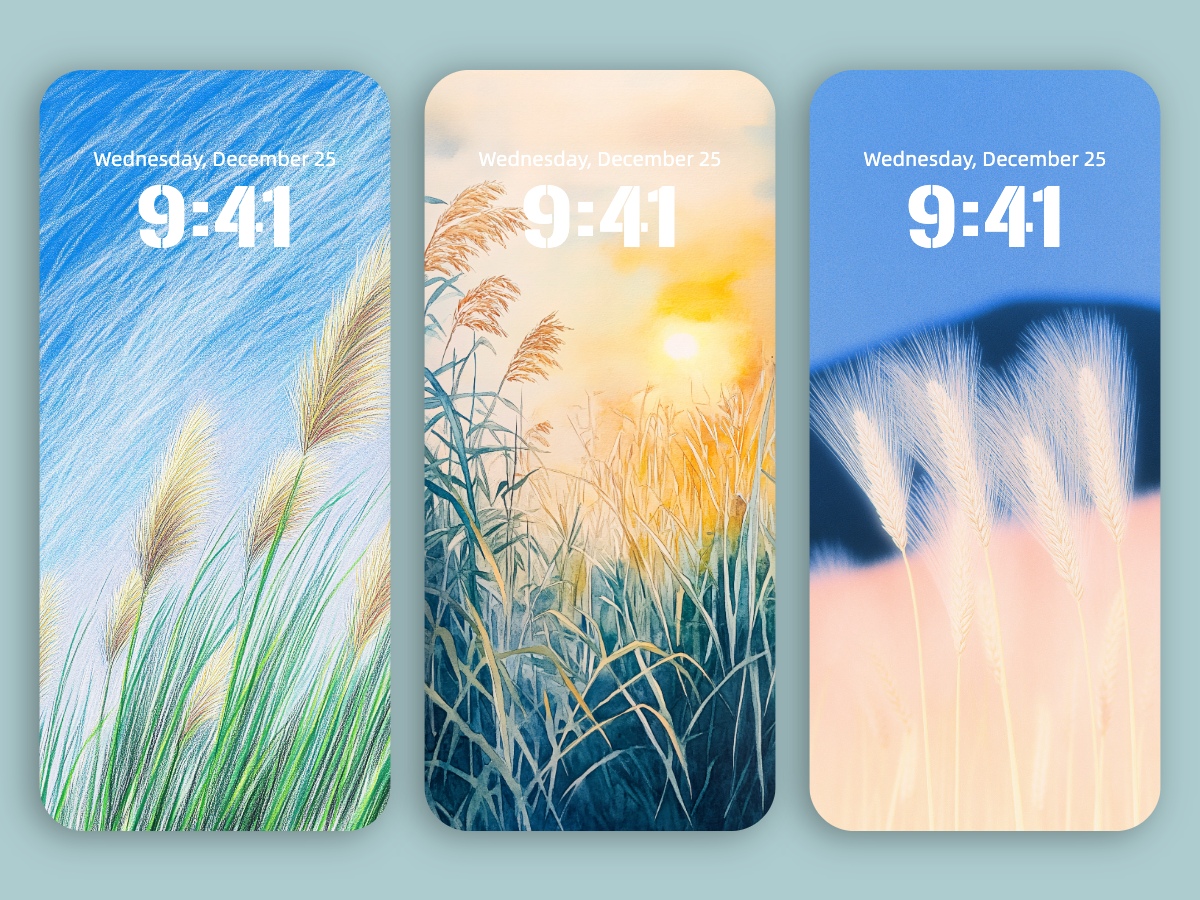

Why do delicate reeds keep showing up in ancient paintings and our dreams? Maybe it’s their quiet beauty, their gentle sway, or the way they stand tall in still waters — whatever the reason, they’ve officially become the new aesthetic obsession. Our Dreamy Minimal Reeds phone wallpapers bring this timeless symbol of calm to your screen in stunning 8K quality, designed for both iPhone and Android. Blending soft earth tones, subtle gradients, and a whisper of ancient inspiration, these backgrounds feel like a serene daydream frozen in time. Each image captures the poetic silence of nature, echoing the peaceful spirit of traditional East Asian art with a modern minimal twist. Whether you’re a fan of historical symbolism, cozy minimalism, or simply need a break from digital chaos, these wallpapers offer a visual exhale — a moment of calm right in your hand. Ready to turn your phone into a meditative art piece? The reeds are waiting.
You can download all these wallpapers on Dejavu Wallpaper!
Experience the magic of AI in advance! Let the infinite imagination of AI decorate your screens, bring you fresh delights every day.


Are reed leaves poisonous? Not really—but they have a history of mistaken identity. In ancient Egypt, people made paper from “papyrus,” a plant that looks like reeds but isn’t actually the same species. Real reeds grow all over the world, but they’re often dismissed as just “swamp decor.” Some even believe the edges are sharp enough to cut skin! The truth? Reed leaves contain tiny silica cells, giving them a rough, sandpaper-like texture. Unless you’re aggressively scrubbing your face with them (please don’t), they’re totally harmless.
Why Do So Many Ancient Paintings Feature Reeds?
Reeds are basically the introverts of the plant world—quiet, unassuming, and swaying gently in the breeze. Ancient scholars loved them because they symbolized a humble, go-with-the-flow attitude. In traditional Chinese ink paintings, reeds often appear alongside fishing boats, cold riverbanks, and lone herons, creating a melancholic yet peaceful atmosphere. Some of the earliest depictions date back to the Song Dynasty, with artworks like In the Depths of the Reed Marsh even being gifted to famous poets.
Have Reeds Ever Taken Over?
Oh, absolutely—sometimes with chaotic results. Reeds are what ecologists call “pioneer plants,” meaning they spread fast and dominate wetland areas, often at the expense of other species. In the U.S., certain reed species are even considered invasive! Scientists once tried using goats to control them, thinking they’d munch the reeds into submission. The result? The goats had a great feast, but the reeds grew back faster than before. A classic case of nature laughing in the face of human plans.
Why Do Surrealist Artists Love Reeds?
Reeds have an almost dreamlike quality—tall but never quite straight, delicate yet unbreakable, like something halfway between reality and a mirage. That’s why surrealist artists often use them as “visual thresholds” between the known and the unknown. René Magritte, for example, liked to place plant silhouettes over faces, revealing only an eye or a glimpse of skin. This “half-hidden” effect turns reeds into a poetic, mysterious transition between the seen and the unseen.
How Did Reeds Get a Voice?
Believe it or not, reeds have been making music for centuries. In ancient Greece, the god Pan supposedly crafted his flute—yes, the famous Pan Flute—from reeds after a failed love story. Legend has it he fell for a nymph, got rejected, and when she turned into reeds to escape him, he cut them down and turned them into an instrument. Dark? Maybe. Iconic? Definitely. Today, variations of the Pan Flute still exist in places like Peru and the Balkans, where they produce the same haunting, wind-like melodies.
Reeds whisper when the wind blows, but most of the time, they just stand there, silent and waiting. Maybe that’s why they feel so at home in paintings and dreams—they exist in that liminal space between stillness and sound, reality and illusion.