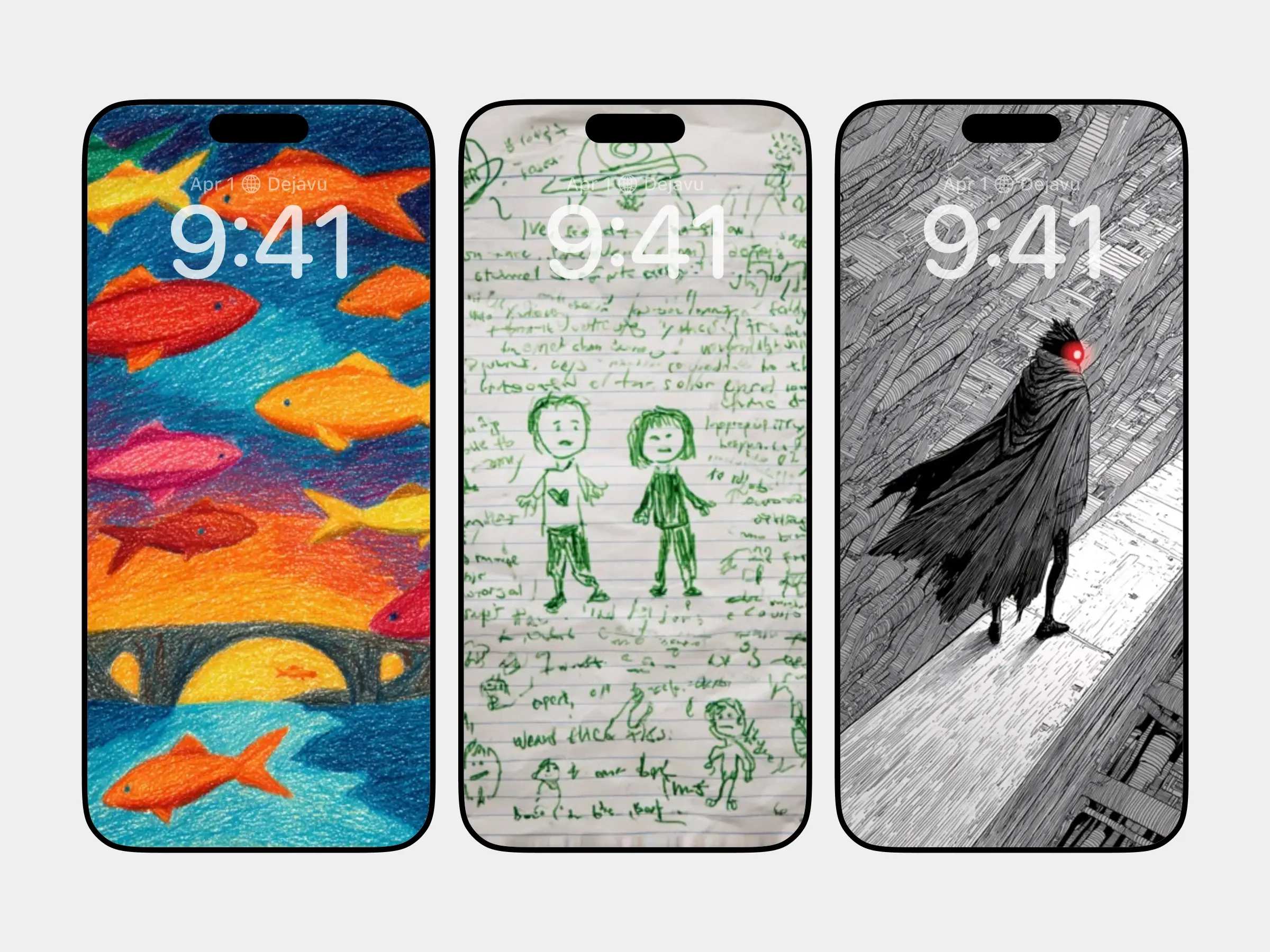

Children’s drawings reveal a powerful blend of innocence and imagination, where logic bends and emotions take shape through vibrant colors and imaginative scenes. These artworks capture the essence of early creativity, blending fantasy with emotional truth. From underwater adventures to dinosaur encounters, each piece reflects a unique worldview shaped by wonder and curiosity. The expressive style offers timeless appeal for those who value authenticity and joy in art.
You can download all these wallpapers on Dejavu Wallpaper!
Experience the magic of AI in advance! Let the infinite imagination of AI decorate your screens, bring you fresh delights every day.


Related Products


Colors dance across paper, lines grow from emptiness. Each child’s drawing is an untamed intellectual expedition, a moment when cognition remains unformatted by social rules. These works are not copies of reality but direct projections of inner universes. Schools of fish swim toward rainbow bridges, cyclists cross waterfalls, dinosaurs stand beside humans on blue seas—these scenes transcend logic yet feel emotionally true. They ignore perspective and proportion, yet rebuild the world with primal order. What children draw with crayons and pencils is not just imagery but metaphor: bridges connect the unknown, suns smile, animals and humans share the same sky. This mode of expression reveals humanity’s most authentic creative impulse—without purpose, simply to exist. Beyond the rational framework of adult life, children’s imagination expands freely, transforming the ordinary into miracles. This unconscious creativity is the initial engine of cultural evolution.
Symbolic Language in Children’s Art
Red fish, yellow suns, blue seas—these colors are not random choices but direct encodings of emotion. Warm hues represent vitality and hope; cool tones symbolize calm and depth. When a child draws a glowing sun, they are not merely depicting a celestial body but expressing a sense of warm presence. The frequent appearance of bridges is more than physical structure—it signifies psychological transition: from known to unknown, individual to collective. Waterfalls become pathways, channels of adventure rather than natural barriers. These symbolic systems form independent languages whose meanings extend far beyond the visual.
Imagination as Cognitive Tool
Children’s drawings reveal the mechanics of nonlinear thinking. Time can overlap, space can fold, creatures coexist in one scene. This is not chaos but a highly flexible cognitive model. For instance, a person walking on water while whales leap above breaks real-world boundaries yet follows internal logic. Such thinking is often deemed ‘unrealistic’ by adults but holds unique value in creative problem-solving. It allows infinite expansion of hypotheses, rejects preset answers, and nourishes innovation.
Cultural Insights from a Child’s View
These artworks remind us that cultural construction begins with individual subjective experience. Each child interprets the world in their own way, and these interpretations collectively form the foundation of shared memory. When they draw aliens, future cities, or mythological beings, they are actively participating in cultural reproduction. Their drawings lack copyright, market value, yet contain pure narrative instinct. In the digital age, such spontaneous expression is increasingly replaced by standardized templates. Protecting this raw creativity means preserving the diversity of human spirit.