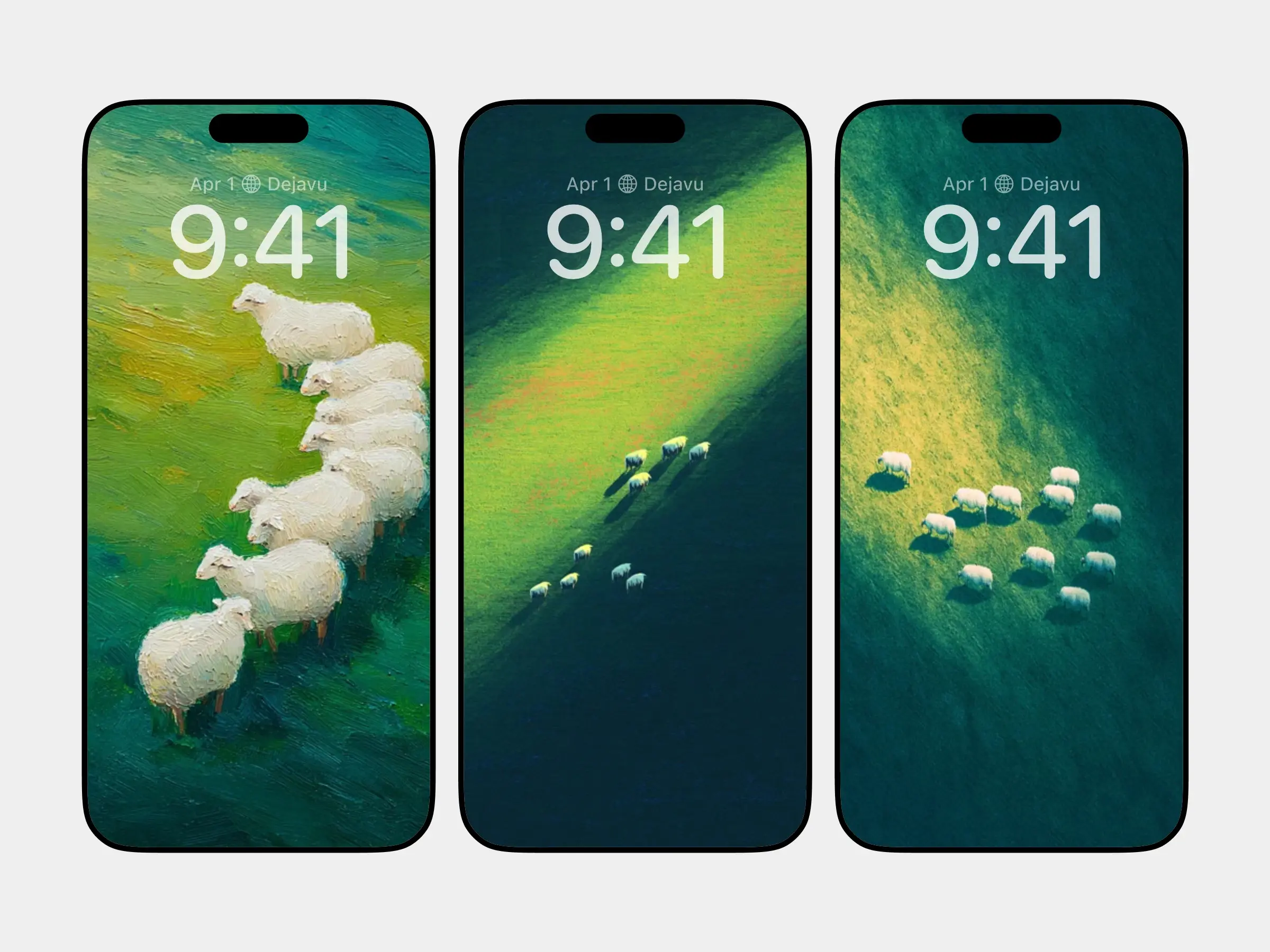

Sheep herds form powerful visual metaphors for collective behavior and individual identity. These images capture their movement across vast landscapes, revealing patterns of unity, rhythm, and subtle defiance. Through aerial views and close-up moments, the scenes explore how nature balances order with solitude, using light, shadow, and formation as tools of expression. The result is a contemplative journey into the quiet philosophy of animal life.
You can download all these wallpapers on Dejavu Wallpaper!
Experience the magic of AI in advance! Let the infinite imagination of AI decorate your screens, bring you fresh delights every day.


Related Products


In a rolling expanse of green, sheep exist in various forms. They move in single file like lines on a timeline, gliding slowly between light and shadow; or scatter into circles, as if inscribing symbols yet to be decoded upon the grass. These white creatures are not merely pastoral ornaments but living philosophies within natural order. Their paths reflect both instinct and collective awareness. When one breaks from the line, it becomes the center, its silhouette elongated, standing apart as a questioner outside the group. This separation is not chaos, but quiet resistance—a test of uniformity.
The Rhythm of the Group
The arrangement of the herd displays a near-ritual rhythm. From above, they resemble pearls strung across the earth, each precisely positioned behind the previous one’s shadow. This alignment is not imposed, but shaped by environment and instinct. As sunlight slants, shadows stretch into dark trails, acting as guides of fate. Their direction always leads toward brightness, yet their pace remains slow and steady, as though awaiting a signal. This unhurried tempo holds immense internal power, synchronizing the entire group.
The Gaze of Solitude
In every composition, one sheep stands apart. It walks ahead, veers off course, or faces directly forward. Its gaze is clear—neither fearful nor hopeful, only purely present. In this sea of white, it is the sole anomaly. Its fleece may be slightly lighter or warmer in tone, but more importantly, its posture—unyielding, unsheltered. This gaze is a silent declaration of individuality within collectivity. It does not seek understanding nor acceptance; it simply exists.
Order in Light and Shadow
Light here is not just physical—it is social metaphor. Sunlit areas symbolize openness and freedom, while shadows represent constraint and belonging. Most sheep remain at the boundary of light and dark, neither fully embracing illumination nor surrendering to obscurity. This balance reflects a delicate choice between safety and exploration. Their shadows shift with time, sometimes overlapping, sometimes diverging, mirroring the evolving dynamics within the group. This dynamic order is more vital than static rules.
Symbols in Nature
The formations of the herd often create geometric patterns—lines, arcs, circles. These shapes are not random but emerge from natural laws and animal behavior. They appear as texts written on the land, recording seasonal cycles and ecological rhythms. Humans have long seen sheep as symbols of gentleness, but in these scenes, they reveal another quality: discipline, unity, and occasional rebellion. They are not passive subjects, but active agents drawing their own maps with their bodies.