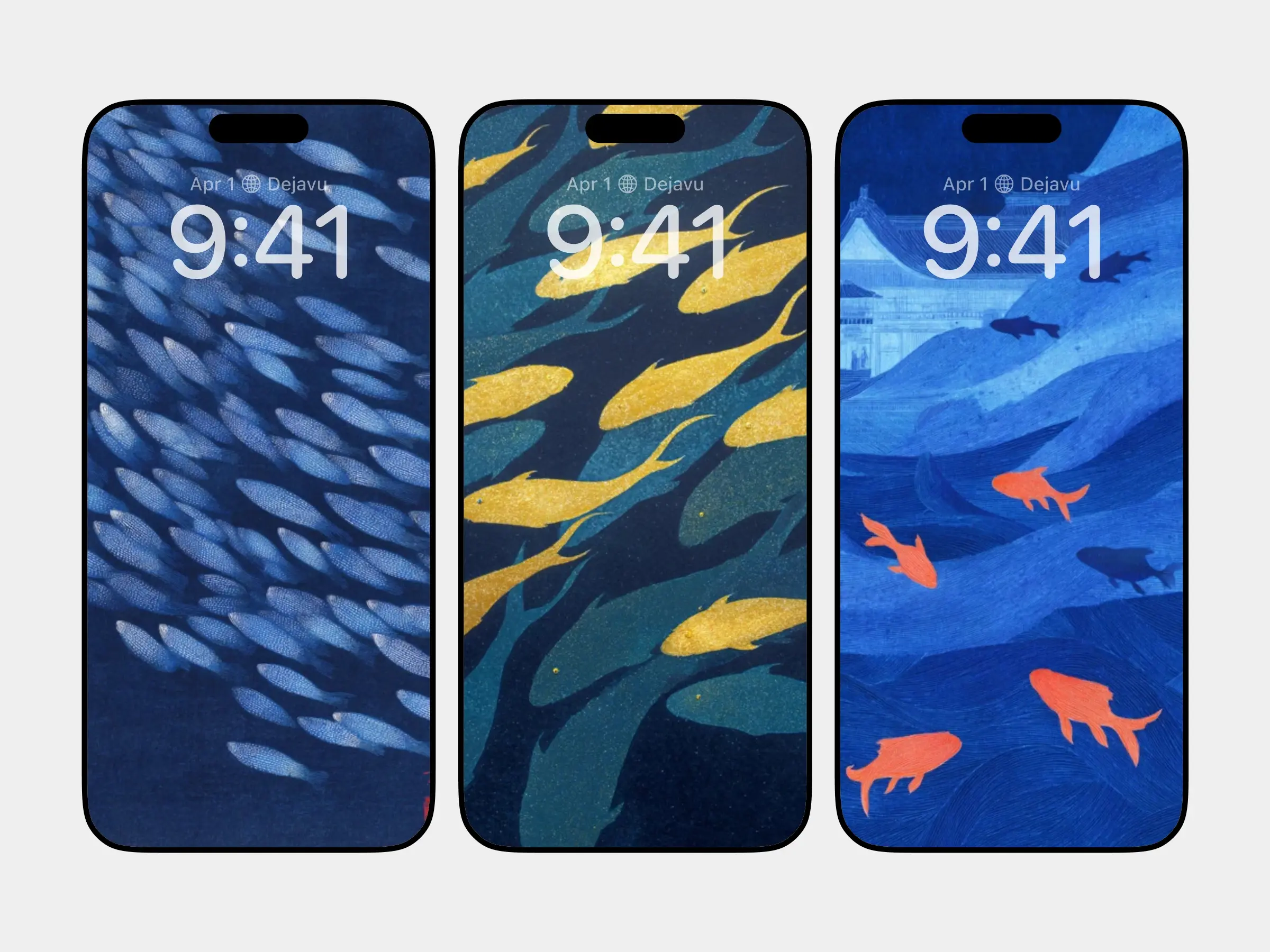

Eastern water landscapes come alive through intricate fish patterns and flowing ripples, blending nature, philosophy, and artistry. These visuals capture the quiet harmony between movement and stillness, reflecting deep cultural meanings rooted in tradition and perception. From golden koi to shadowy schools, each element tells a story of balance, freedom, and the ever-changing rhythm of existence.
You can download all these wallpapers on Dejavu Wallpaper!
Experience the magic of AI in advance! Let the infinite imagination of AI decorate your screens, bring you fresh delights every day.


Related Products


On a deep blue ground, schools of fish spread like ink stains, each scale glowing as if breathing within hidden currents. They do not pursue direction nor linger; they move only with the undulations of water, forming an unspoken order. This movement is not chaos but a tangible expression of natural rhythm—water shapes the fish’s path, and the fish, in turn, define the contours of the water. This is more than visual representation; it is a cultural memory preserved: from ancient debates on the riverbank to legends of golden koi in garden ponds, water and fish have long served as metaphors in Eastern thought for freedom, perception, and modes of being.
The Grammar of Water
Water here is not background but language. Through variations in ripple density, line direction, and light contrast, it forms a visual grammar. Fish become the subject of this syntax, their paths the predicate. In some compositions, the surface is drawn as layered arcs, resembling slices of time; others place still architecture as reference, hinting at the tension between human civilization and natural flow. Water’s grammar rejects straight lines—it always curves, loops, branches—as if expressing an unruly rhythm.
The Philosophy of Fish
Fish vary in form and color, from silver-gray to crimson gold, yet share a common trait: non-centrality. No leader, no defined hierarchy, yet they achieve sudden consensus. Behind this collective behavior lies a precise interplay of instinct and environmental feedback. In traditional thought, fish symbolize persistence against odds, especially in Zhuangzi, where fish converse with humans about the essence of freedom. Here, fish are both living creatures and spiritual projections—they swim through water as people walk through life, seeking their own invisible river.
The Politics of Color
Blue dominates, but not uniformly. Deep oceanic tones, indigo, and sky-blue intertwine to create rich spatial depth. Golden fish introduce ritualistic luminosity, appearing as chosen individuals emitting faint but resolute signals in darkness. Red fish carry stronger narrative weight, often near shores or structures, acting as bridges between reality and imagination. Color here is not mere decoration but meaning-bearing: cool hues signify eternity, warm ones mark fleeting life-light.
The Poetry of Space
Some scenes merge mountains and buildings into the water, blurring land and sea. Architectural silhouettes float above the surface, like ruins from dreams, suggesting the fragility of civilization against nature’s permanence. Fish pass through these forms, reminding viewers that even the most solid constructs will eventually be swallowed by time’s current. Space here is not geometric but psychological—fluid, forgotten, rediscovered.