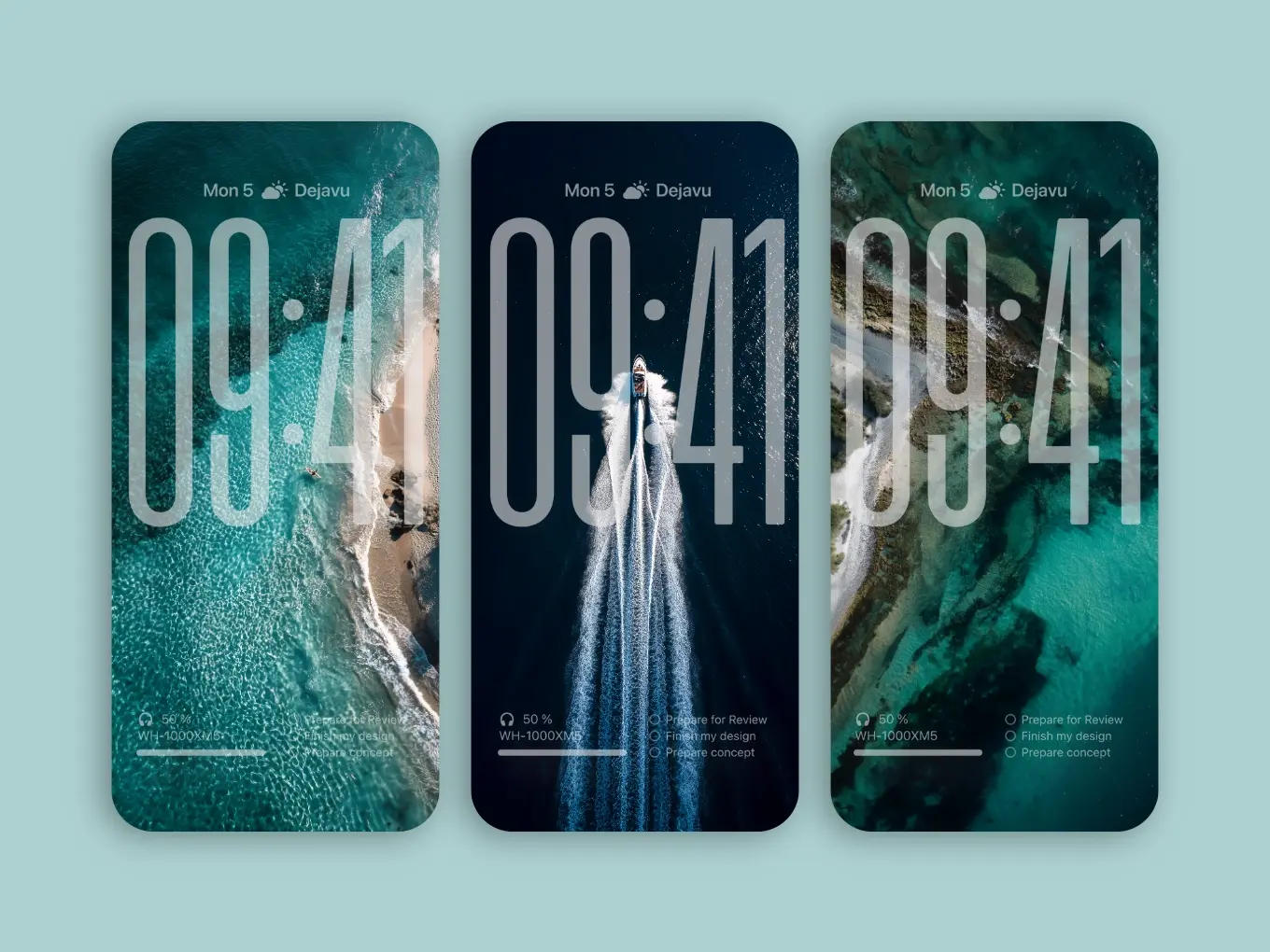

Dive into a world where art meets physics — The Art and Science of Wakes transforms the subtle geometry of waves into mesmerizing minimal wallpapers. Each design captures the silent poetry of motion, the delicate trails carved by wind and water, and the hypnotic symmetry found only at sea. Perfect for iOS 26, iPhone, and Android devices, these 8K ultra-HD wallpapers bring a serene yet intelligent aesthetic to your screen. Whether you’re a lover of calm ocean tones, a minimalist design fan, or someone who appreciates visual balance, this collection turns your phone into a window to the rhythm of nature. Download and feel the geometry of the sea — pure, precise, and endlessly fascinating.
You can download all these wallpapers on Dejavu Wallpaper!
Experience the magic of AI in advance! Let the infinite imagination of AI decorate your screens, bring you fresh delights every day.


When a vessel cuts across the deep blue ocean, it leaves behind a long white trail. This wake is not “paint,” but the result of propellers and hull disturbing the flow of water, breaking its surface tension, and creating countless tiny bubbles. These bubbles reflect sunlight, forming a ribbon of white that unfurls clearly against the blue canvas of the sea.
What science hides within a wake?
A ship’s wake is a visible expression of fluid dynamics. As the propeller churns, it stirs the water into turbulence, drawing in air and creating what is known as “wake turbulence.” Scientists have even used satellite images of wakes to calculate vessel speed and emissions. In other words, those elegant ribbons at sea are not only striking visuals but also valuable data for monitoring maritime activity.
Why do wakes take different shapes?
From above, some wakes stretch like straight lines, others arc gracefully, while some swirl into circular ripples. Straight lines emerge when ships sail steadily; arcs and rings appear when they turn or circle. To artists, these water lines resemble “calligraphy on the sea”—each stroke inscribing motion across an endless blue sheet of paper.
How does art intertwine with these patterns?
Minimalist photographers often favor such scenes: a boundless expanse of blue ocean punctuated only by a tiny boat and its single white trail—an image at once simple and powerful. Modern artists go further, abstracting wakes into geometric forms that echo 20th-century Suprematist painters, who sought to depict pure motion through geometry. In their eyes, the sea becomes not just water, but a living canvas of moving lines.
Could a wake be a kind of “oceanic signature”?
Every ship leaves behind a wake as unique as handwriting. Engine power, velocity, propeller size, and even the texture of the waves shape its form. From this perspective, a wake becomes a fleeting but distinctive “signature” of a vessel—temporary to the naked eye, yet immortalized in satellite imagery and photography.
Seen scientifically, a wake is the outcome of hydrodynamics; seen artistically, it is a minimalist drawing on the sea. Next time you gaze down at the ocean from above, you may notice: those white trails are not merely paths of ships, but geometric poems marking the dialogue between human craft and the living sea.