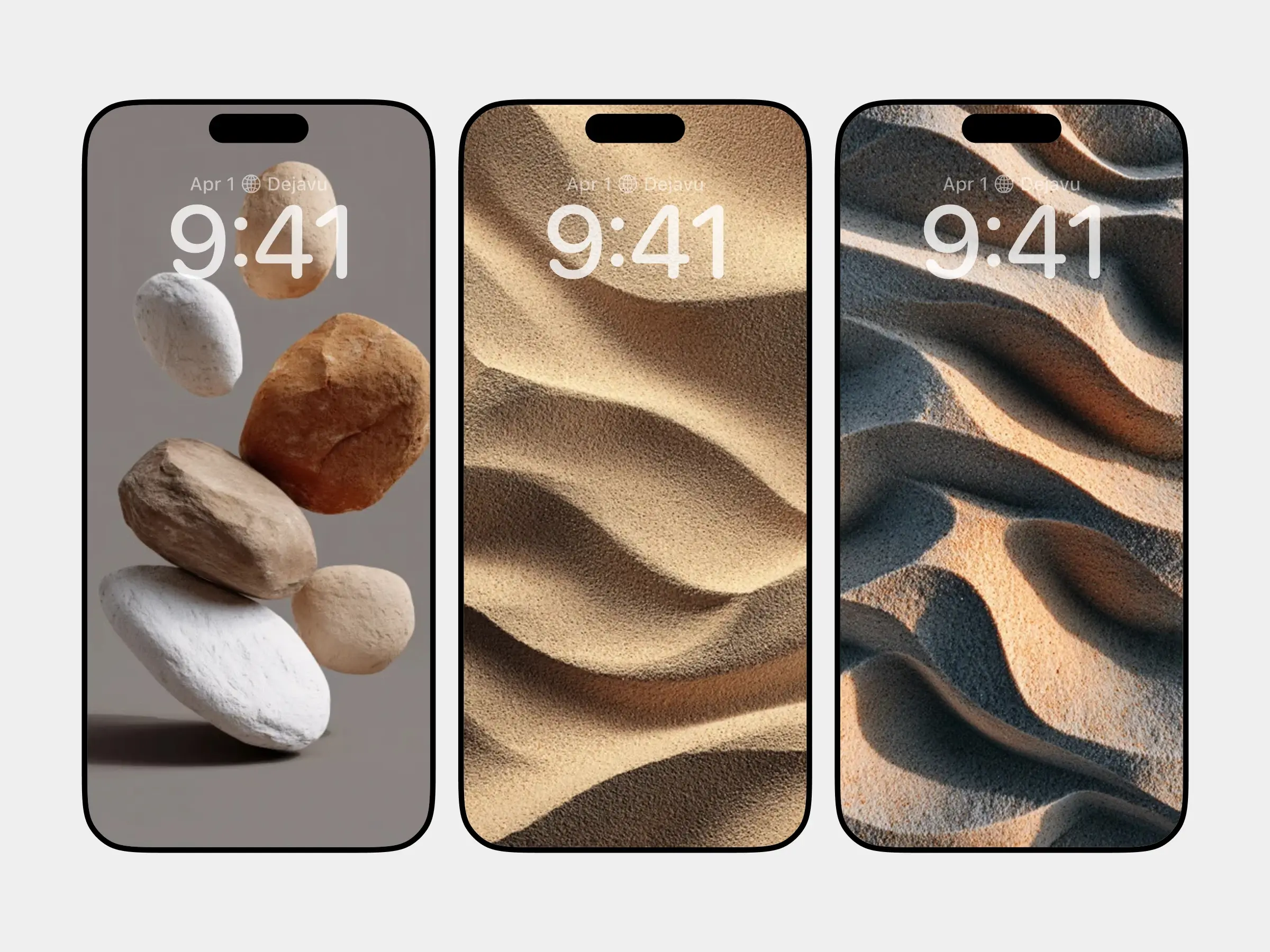

Sand and stone form a timeless dialogue in nature’s quiet moments. This minimalist composition explores the balance between motion and stillness, impermanence and endurance. Inspired by Zen aesthetics and desert landscapes, the interplay of texture, light, and form reveals deeper philosophical truths about existence and simplicity.
You can download all these wallpapers on Dejavu Wallpaper!
Experience the magic of AI in advance! Let the infinite imagination of AI decorate your screens, bring you fresh delights every day.


Sand shifts under wind, forming wave-like patterns as if time itself were carving the earth. Stones rest within it, smooth in texture, rounded in form, shaped gently by years of exposure. Their presence is not one of conflict, but of coexistence—a silent balance. Each ripple in the sand records the direction of the breeze; each grain tells a story of movement. This natural order does not rely on language, yet it approaches truth more closely than any words ever could. It is a philosophy without explanation, an aesthetic born between matter and void.
The Rhythm of Sand
Sand’s form is never fixed. It rearranges with every gust of air. Wind acts as an invisible sculptor, shaping undulating lines through constant touch. These curves are not random—they are manifestations of natural law. Light passes over the ridges and hollows, casting shadows of varying depth, giving the surface a three-dimensional rhythm. This is more than terrain; it is a visual poem of time. In unseen corners, sand continues to write its own history.
The Silence of Stone
Unlike sand, stone resists change. Its substance is firm, its edges defined. Even after prolonged exposure to nature, it retains its integrity. Yet it does not exist alone. When a stone settles onto sand, ripples radiate outward like water waves. This is a symphony of strength and softness, stillness and motion in harmony. The stone, in its immobility, becomes an anchor in a world of flux.
Zen Spaces
In Japanese rock gardens, sand and stone symbolize cosmic order and impermanence. Through minimal elements, boundless meaning is created. There is no ornamentation—only carefully placed stones and raked sand. The patterns represent flowing water; the rocks stand for islands or mountains. A viewer pauses here, mind gradually quieting. This is not scenery, but inner contemplation. It reminds that true beauty lies in emptiness and restraint.
Nature’s Cadence
Whether it is wind-swept dunes or stones beneath rippling water, nature follows an internal rhythm. The interplay of light and shadow, solid and void, forms a harmony beyond human comprehension. This cadence is not auditory—it resides in form. It requires no technology, no interpretation—only presence. When thought ceases, this silent beat can be felt.
The Poetry of Matter
Both sand and stone are components of Earth, yet their differing forms reveal distinct spiritual qualities. Sand represents change; stone, permanence. Sand embodies process; stone, outcome. Together, they reflect nature’s dualities. Amidst urban noise, such contrast feels especially precious. It awakens longing for simplicity, purity, and eternity. Not escape, but a renewed understanding of being.