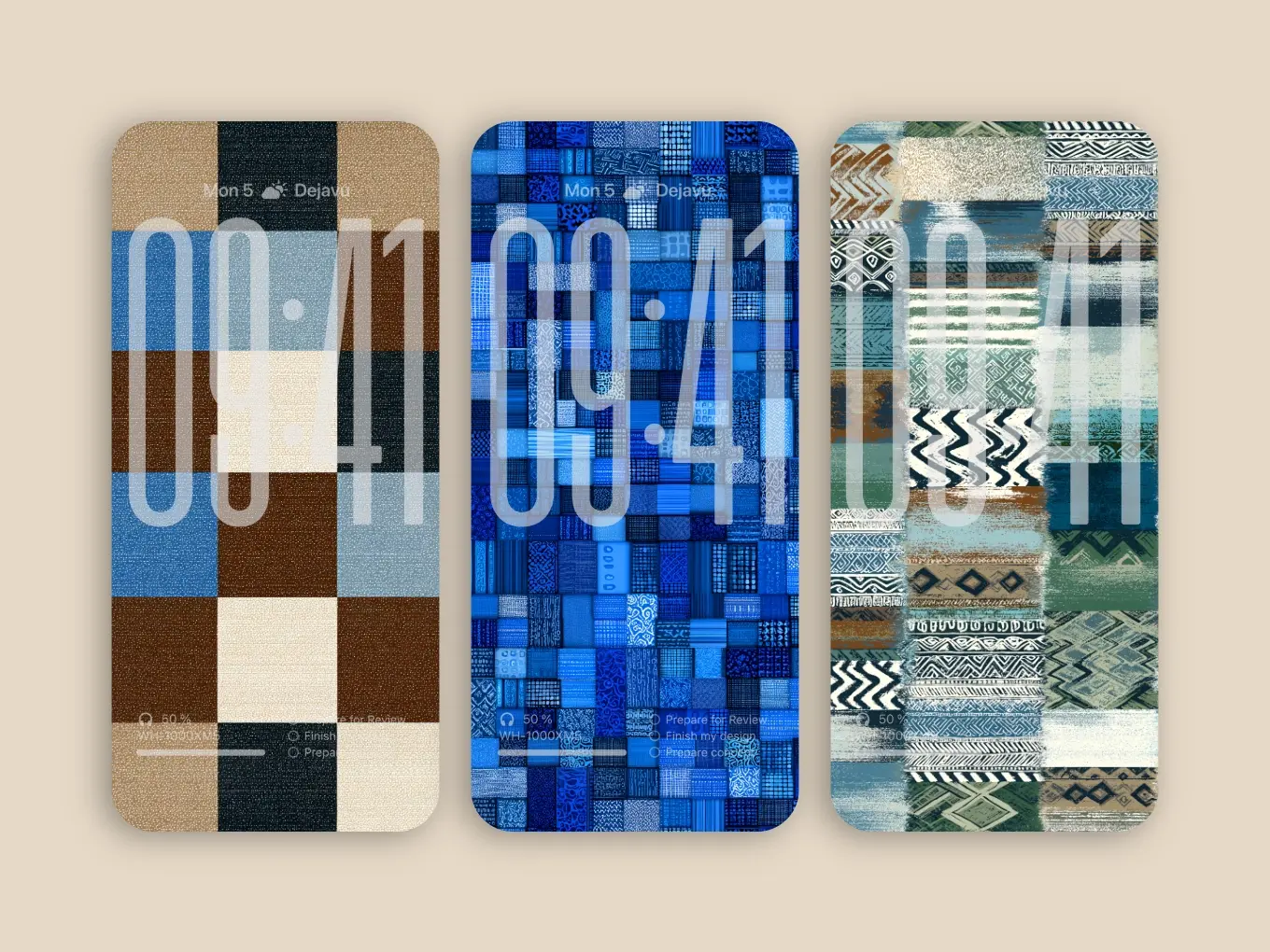

Step into the hidden geometry of time with A Brief Secret History of the Grid. These ultra-sharp 8K minimal wallpapers for iPhone and Android transform your screen into a modern echo of ancient cities and pixel-perfect balance. Every line, every rhythm whispers the quiet logic behind order and beauty — from stone streets to digital screens. Perfect for those who love symmetry, simplicity, and a touch of design history right in their pocket. Download now and give your device that serene, architectural calm only pure geometry can bring.
You can download all these wallpapers on Dejavu Wallpaper!
Experience the magic of AI in advance! Let the infinite imagination of AI decorate your screens, bring you fresh delights every day.


If you’ve ever noticed repeating squares and tessellations on rooftops, floor tiles, fabrics, or even your phone screen, don’t dismiss them as mere decoration.
These geometric grids are, in fact, one of humanity’s oldest “codes of order.”
Who Were the First “Geometric Geniuses”?
The history of geometric grids can be traced back to around 4000 BCE in Mesopotamia. Archaeologists have discovered repeating diamond and triangle motifs on Sumerian pottery. Some believe these patterns were not purely decorative but served as early measuring tools—using repeated grids to gauge the vessel’s capacity and proportions.
In other words, those designs may have been the ancient world’s rulers in disguise.
Tessellations: A Collaboration Between Artists and Mathematicians
By the medieval era, tessellated structures became hallmarks of Islamic art.
Bound by religious principles discouraging figurative imagery, artists created breathtaking designs purely from geometry—octagonal stars, hexagons, and arabesques woven seamlessly into infinite patterns.
This was not only aesthetic but also a display of mathematical brilliance.
It wasn’t until the 20th century that mathematician Roger Penrose proved, through “aperiodic tiling,” that some tessellations never repeat exactly—a concept that feels like magic but is pure mathematics.
How Did Grid Textures Enter Modern Life?
The Industrial Revolution brought grids down from palaces into factories and homes. Textile machines relied on grids to weave fabrics; urban planners used chessboard-style streets to optimize traffic; even modernist architect Le Corbusier designed window layouts and facades using grid-based proportions.
He once remarked: “The grid is a dialogue between order and freedom.”
Today, the grid is the invisible backbone of the digital world. The pixel matrix on your phone screen is essentially a miniature grid—each pixel fitting together like ancient tiles to form an image. Without grids, there would be no high-definition reality.
A Fun Fact: Grids Can Affect Mood
Psychological studies show that regular geometric grids evoke a sense of safety, as their predictability and extendability send stabilizing signals to the brain.
This is why shopping malls often use grid-patterned tiles—attractive to look at, and subtly encouraging people to linger.
From ancient pottery to modern screens, from palace domes to home carpets, geometric tessellations and grid textures form an invisible thread of civilization—interweaving art, mathematics, and everyday life.
The next time you see blue tiles or repeating patterns, remember: you’re standing on thousands of years of “grid culture.”