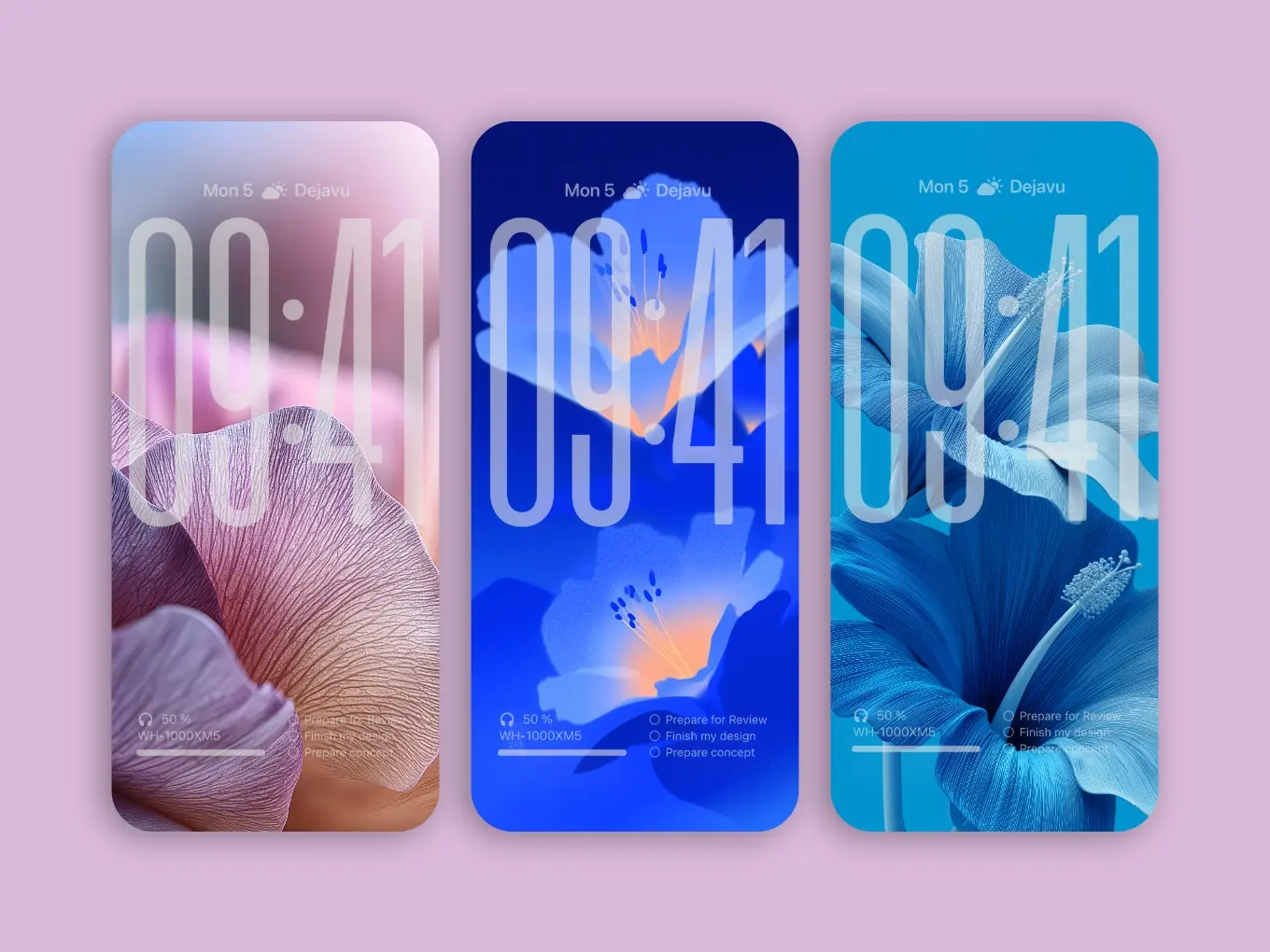

Bring serenity to your screen with Minimalist Petal Aesthetics, an 8K wallpaper collection inspired by the quiet beauty of a single flower. Perfect for iOS 26, iPhone, and Android, each design blends simplicity and elegance to create a calming visual escape. Whether you love clean minimalism or subtle natural vibes, these wallpapers turn your device into a piece of art — pure, modern, and effortlessly beautiful.
You can download all these wallpapers on Dejavu Wallpaper!
Experience the magic of AI in advance! Let the infinite imagination of AI decorate your screens, bring you fresh delights every day.


To most of us, petals are merely soft ornaments. But when observed through a minimalist lens, they reveal themselves as finely tuned designs of nature. Delicate veins, translucent layers, and silk-like folds all carry hidden stories where science and art converge.
What Are the “Fingerprints” on a Petal?
Look closely at the surface of a petal, and you’ll find patterns as unique as human fingerprints. Scientists call them “epidermal cell ridges.” These microscopic folds bend light, creating soft halos of glow in sunlight. Some flowers even use ultraviolet stripes— invisible to humans but clear to bees— as “runways” guiding pollinators toward nectar.
Why Do Petals Feel Like Silk?
The softness comes from structure. Unlike stiff leaves, petal cell walls are rich in pectin and water, forming natural “sponges.” This gives petals a translucent shimmer under light. Japanese horticulturists once noted that peony petals at dusk glow with the same sheen as silk cloth, inspiring a kimono dyeing craft called “flower-shadow weaving.”
Why Do Minimalists Love Petals?
In design, petals are seen as symbols of simplicity carrying layered meaning. With just a curve or outline, they suggest lightness, rhythm, and breath. The Bauhaus movement of the 20th century even studied petal forms when designing architectural curves, believing natural minimalism outshines rigid geometry. Today, digital artists scan petal textures into computers, transforming them into gradient fields and abstract lightscapes.
Can a Petal Generate Power?
Surprisingly, yes—indirectly. Researchers found that microstructures on petals act like “photonic crystals,” improving light absorption. By imitating the textured surface of rose petals, engineers enhanced solar panel efficiency, trapping photons that would otherwise escape. A single petal’s design may one day reshape renewable energy technologies.
Petals as Timekeepers
Beyond aesthetics, petals are records of time. Botanists discovered that petal vein growth reflects local humidity and temperature. Ancient pressed-flower specimens, with preserved vein patterns, reveal climate conditions of centuries past. In this way, petals act as natural archives, bridging art and environmental science.
Minimalist petal aesthetics remind us: every petal is more than decoration. It is a coded design, a scientific puzzle, and an artistic inspiration. The next time you trace the fine lines of a petal, consider this—what you hold is not just beauty, but nature’s quiet password.