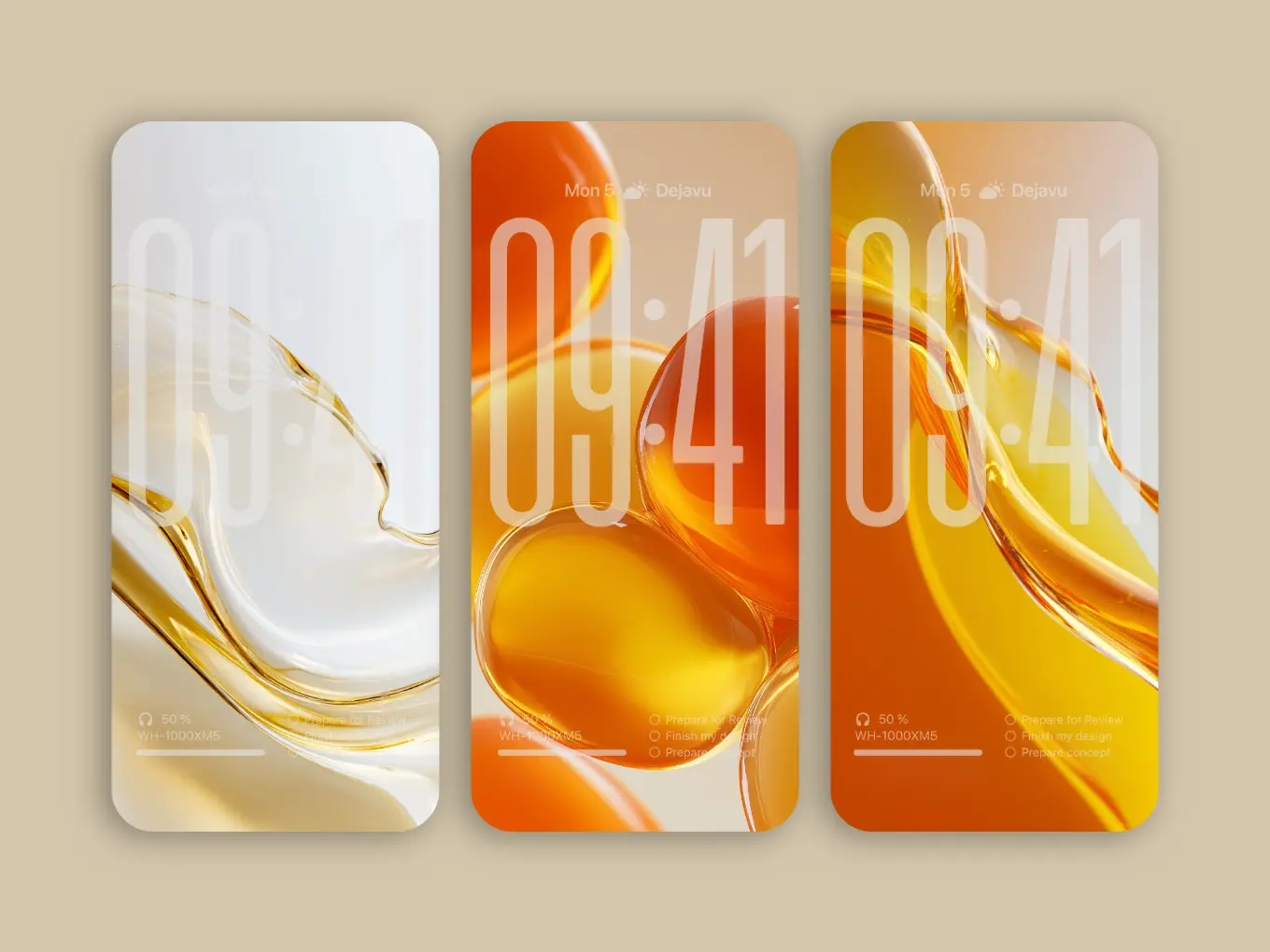

Dive into the mesmerizing world of Liquid Glass Art — a fusion of minimalism and futuristic shine. These 8K wallpapers are crafted to look like flowing crystal, perfect for giving your iPhone or Android a sleek, next-gen feel. Inspired by iOS 26’s refined aesthetic, every background brings calm, clarity, and a touch of sci-fi luxury to your screen. Download your favorite now and let your phone glow like liquid light.
You can download all these wallpapers on Dejavu Wallpaper!
Experience the magic of AI in advance! Let the infinite imagination of AI decorate your screens, bring you fresh delights every day.


From the moment humans first discovered how to fire glass, fascination with this transparent yet solid material has never waned. But what many don’t realize is that glass isn’t entirely solid—it is what scientists call a “supercooled liquid.” Its molecular structure resembles droplets frozen in motion, suspended between solid and liquid states. In fact, the stained-glass windows of some 19th-century European cathedrals are measurably thicker at the bottom than at the top, a subtle trace of glass’s slow, time-bound “flow.”
How Did Liquid Glass Enter the Arts?
Modern designers draw inspiration from nature’s flowing shapes, capturing the instantaneous posture of liquids in static images. The abstract capsules, bubbles, and floating gels you see often mirror the behavior of droplets in zero gravity. On the International Space Station, scientists once released water in microgravity and observed how droplets fused into near-perfect spheres. The results advanced aerospace science—yet also inspired artists to transform the sensation of “weightless liquidity” into a visual language of soft, suspended forms.
What Is the Secret Behind Gradient Colors?
Gradients are more than an aesthetic flourish. They echo natural optical phenomena: rainbows from refracted sunlight in water droplets, or oil-slick iridescence from thin-film interference. In digital art, gradients carry an extra psychological layer. Studies show that viewers engage longer with gradients than with flat blocks of color, because gradients trigger a sense of soft transition and continuity. This explains why futuristic visual vocabularies so often pair gradients with liquid-glass textures—together, they create an atmosphere that feels at once futuristic and dreamlike.
Why Does “Floating” Symbolize the Future?
Floating has long represented transcendence. From ancient myths of flying islands to sci-fi visions of weightless space, levitation symbolizes freedom from earthly limits. Liquid glass, with its suspended, hovering forms, embodies this yearning. Remarkably, engineers are experimenting with acoustic levitation—using ultrasound waves to suspend droplets mid-air. What once sounded like science fiction now exists in laboratory prototypes, hinting at possibilities like floating architecture or suspended art installations in the not-so-distant future.
What Story Can a Single Drop Tell?
That translucent oval you see might hold more than abstract beauty—it is a capsule of history and imagination. It carries the miracle of ancient artisans tending furnace fires, the rigor of astronauts conducting experiments in orbit, the physics of molecules inching over centuries, and the poetic visions of artists translating fluidity into sculpture.
The magic of liquid glass lies in this convergence: time, optics, and imagination all crystallized into a single floating form.