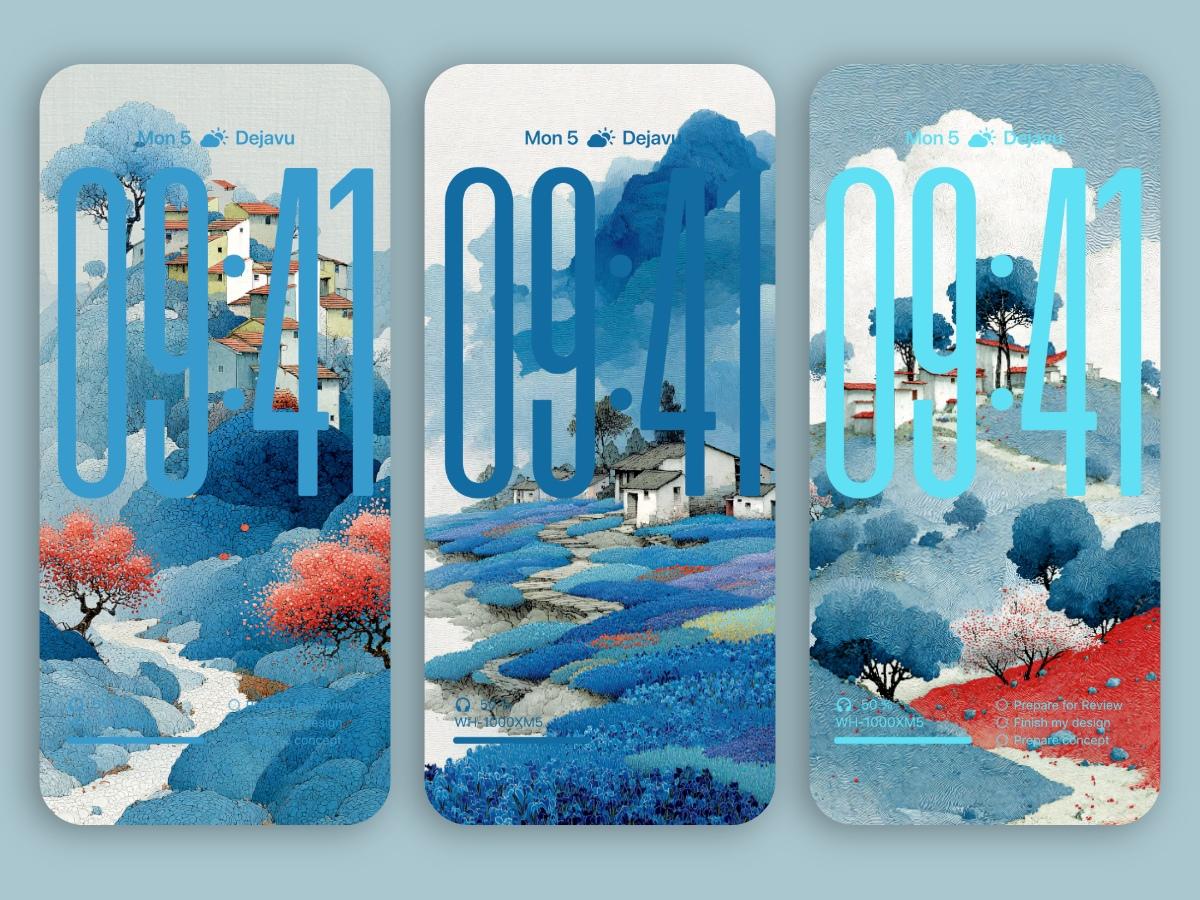

Get ready to give your screen an upgrade with Starlit Mountains: When Van Gogh Meets the Song Dynasty — a stunning collection of 8K minimal phone wallpapers, now optimized for iOS 26 and Android devices. These aren’t your average backgrounds. Imagine the swirling, dreamy strokes of Van Gogh blending seamlessly with the elegant ink-wash serenity of ancient Chinese landscapes. The result? A hypnotic fusion of East and West, tradition and imagination — all in ultra-crisp resolution. Whether you’re rocking the latest iPhone or keeping it Android-classic, these wallpapers wrap your device in calm mountain silhouettes, star-kissed skies, and timeless brushwork that feels both modern and eternal. Ideal for art lovers, design minimalists, and dreamers alike, each piece brings museum-level aesthetic right to your fingertips. Time to unlock your inner zen — in 8K clarity.
You can download all these wallpapers on Dejavu Wallpaper!
Experience the magic of AI in advance! Let the infinite imagination of AI decorate your screens, bring you fresh delights every day.


In an imagined studio beyond time, Emperor Huizong of Song delicately outlines distant peaks and village shadows on silk scrolls. Beside him, a fiery-eyed blond man wields his brush with intensity, whirling and dancing across canvas, leaving trails of fire. This studio doesn’t exist in history—it lives in the interstices of images, where Eastern landscapes and Western starlight collide, giving birth to a surreal visual dialogue.
These images—an unlikely fusion of styles—emerge from that space. They marry the poetic emptiness and composed structure of classical Chinese landscapes with Van Gogh’s whirling strokes and emotional color. The result: a hybrid aesthetic dream where ink flows like stars and hills echo with inner light.
What if Van Gogh Painted Chinese Mountains?
Though Van Gogh never stepped foot in China, he was captivated by the East. In letters, he admired Japanese woodblock prints for their distilled harmony with nature. Song dynasty landscapes, with their meticulous brushwork and spiritual geometry, offer a similar pursuit of cosmic order—ink as universe.
Had Van Gogh seen the dotting techniques or wrinkle strokes of Song painters, he might have recognized a shared rhythm: the obsession with texture, with breathlike space, with nature not as copy but as emotion distilled.
Why Are the Hills Blue and the Fields Red?
In Chinese painting, forms arise from intention. In Van Gogh’s world, color erupts from feeling. The blue hills here are not topographically accurate—they are moods in pigment: post-rain stillness, dusk-bound memory, quiet longing. The red fields blaze like Sunflowers, a metaphor for life burning at the edges. Here, color is no longer a cultural boundary—it is a bridge.
Negative Space vs. Swirling Density
Chinese landscape masters leave space not as absence but as water, mist, or silence. Van Gogh left no room untouched—his canvases pulse with unrelenting texture. In these fused compositions, we find a rare harmony: cottages and cliffs retain the crisp lines of gongbi (fine brush), while trees and skies shimmer with Van Gogh’s turbulent motion.
One philosophy places mountains in the mind. The other pours raw feeling onto canvas. Together, they whisper in balance.
Images as Time Machines
We often think of art styles as locked in time, defined by history and geography. But in an age of AI and hybrid vision, images become temporal vessels. These paintings are not replicas or reinterpretations—they’re something more: a dreamt Renaissance, where a Song scholar dreams of Van Gogh, and Van Gogh dreams of misty river towns under starlit skies.
When we gaze at these images, we are time-traveling. Across cultures. Across techniques. Across two souls who never met but might have shared a single belief—that art is how we plant flowers in silence, and stars in darkness.