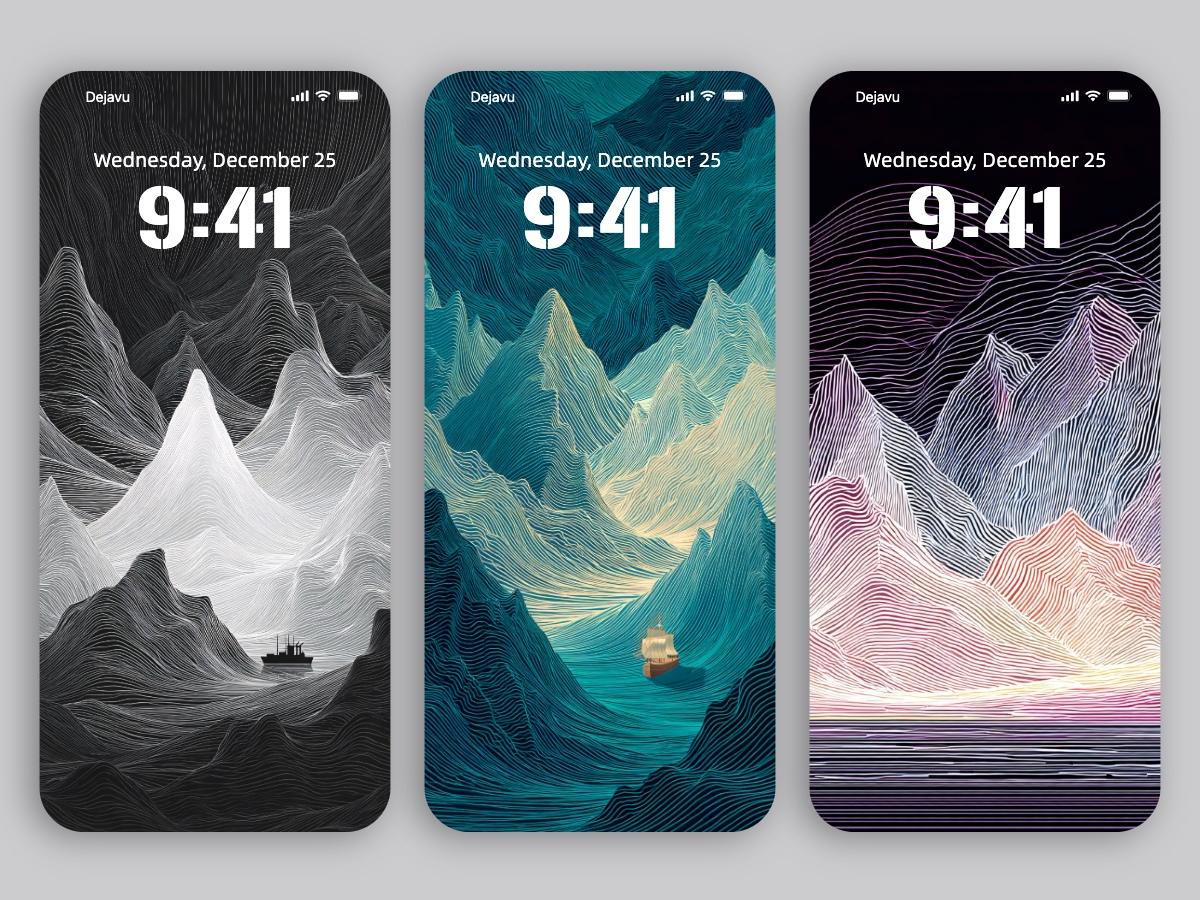

Sail into stillness with our Minimal Landscape Boat Wallpapers in stunning 8K, designed for both iPhone and Android screens. Featuring a solitary boat drifting across delicate contour lines, this wallpaper collection captures the perfect blend of serenity, space, and quiet wonder. Inspired by topographic maps and dreamlike exploration, each design is a visual escape into the unknown — no clutter, no chaos, just a calm sea and a story waiting to unfold. Whether you’re a fan of minimal art, nature-inspired aesthetics, or love the idea of a peaceful journey beyond the edges of the map, these wallpapers turn your phone into a tranquil portal. Perfect for adventurers with a soft spot for silence and simplicity, or anyone craving a fresh, clean look for their screen. Let your device drift into a world of understated beauty — because sometimes, the quietest wallpapers speak the loudest.
You can download all these wallpapers on Dejavu Wallpaper!
Experience the magic of AI in advance! Let the infinite imagination of AI decorate your screens, bring you fresh delights every day.


Somewhere deep in the artistic wilderness, a curious kind of line begins to wander. It doesn’t guide you. It offers no final destination. But it flows like memory, tracing the rise of mountains and the hush of seas with uncanny precision. Welcome to the world of contour line aesthetics — where a tool from geography transforms into visual poetry. In this dreamy series of abstract artworks, stacked lines not only map landscapes, but whisper of inner journeys. And always, somewhere adrift in the unknown, a tiny boat floats on.
Why Did Contour Lines Leave Maps and Enter Art?
Originally, contour lines were serious business — invented to mark elevation on maps, useful for engineers, generals, and surveyors since the 19th century. But lately, they’ve snuck off the map and into sketchbooks, design blueprints, fashion collections, even avant-garde architecture.
Why the crossover? Because contour lines are rhythm disguised as order. Every twist and bend feels like a heartbeat of the Earth — or perhaps the gentle ripple of a thought. For artists, they’re not just topographic markers; they’re echoes of time, memory, and mood.
On canvas, these lines swirl beyond function. They stretch, they loop, they ripple like silk caught in a dream. Sometimes they resemble cliffs, other times ocean waves — and often something in between.
And That Little Boat… What Is It Looking For?
Here’s the mysterious part: no matter how wild the lines get, there’s always a single boat bobbing in the landscape. Sometimes it sails between mountains. Sometimes it rests in a shadowy valley. It looks like it’s searching for a harbor… or maybe hiding from a storm.
That tiny boat is us. It’s the metaphor for all our wandering — emotionally, spiritually, even digitally. We navigate the unknown, always hoping for land, yet strangely drawn to drift.
Centuries ago, explorers would scrawl “Here be dragons” on the edges of maps to mark the feared unknown. Today, GPS may have tamed the globe, but we still get lost — in life, in thought, in late-night doomscrolling. That little boat becomes our stand-in, quietly drifting through a sea of lines and feelings.
Are the Lines Just Art — or Are They Real Geography?
Believe it or not, some of these squiggly lines are based on actual landscapes.
Back in the 18th century, cartographer Matthew Flinders drew ultra-dense contour lines to map Australia’s underwater terrain. In modern times, Japanese artist Akira Yamaguchi reimagined cities as terrain — drawing skyscrapers as topographic peaks, blurring the boundary between concrete and mountain.
So, that dreamlike maze of curves might be part real, part remembered. A coastline you once walked. A mountain from a story. A landscape built from feeling. And the boat? Still adrift, still searching for a place to rest between sea and sky.
Why Can’t We Look Away from Contour Lines?
Psychologists have a theory: humans love patterns with just enough variation. That’s exactly what contour lines deliver — repetitive but never boring, structured yet full of surprises.
They’re even used in art therapy as “meditation lines.” Drawing or staring at them calms the mind, invites curiosity, and leaves space for interpretation. You might see a mountain. I might see sound waves. Someone else sees a heartbeat.
And always, there’s the boat. That quiet anchor for our gaze and imagination. Everyone sees something different in it — a journey, a question, a hope.
So next time you find yourself staring into a sea of swirling lines, remember: that little boat might just be carrying you — toward a map that hasn’t been drawn yet.
Somewhere beyond the final curve, past the last ripple of ink, someone might be waiting for you to arrive.